

Nearly 30,000 Pounds of Beef Recalled: What It Reveals About America’s Food Infrastructure—and South LA Real Estate
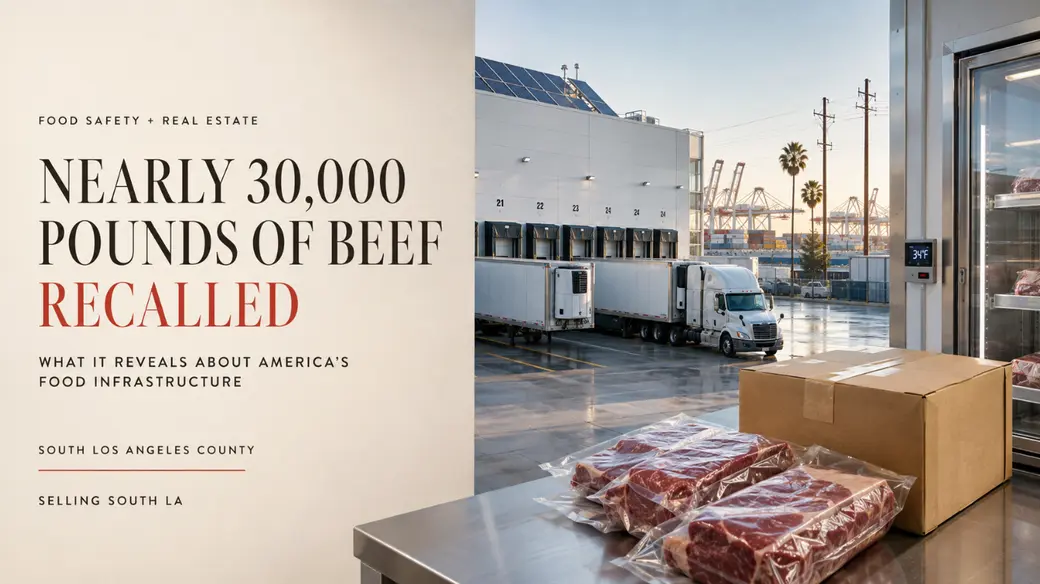
The Beef Recall Making Headlines
Nearly 30,000 pounds of raw beef have been recalled after entering the United States without completing a required federal import-reinspection process.
According to the USDA’s Food Safety and Inspection Service, Florida-based Corte Argentino USA LLC recalled approximately 29,628 pounds of boneless beef imported from Argentina. The products were produced between May 15 and May 20, 2026, and distributed to retailers and distributors in Florida and Texas. They were not reported as distributed in California. USDA Food Safety and Inspection Service
There have been no confirmed reports of illness or injury associated with the recalled products. The recall was initiated because the beef entered commerce without the required FSIS reinspection—not because contamination had already been confirmed.
That distinction matters. This is not simply a story about “bad foreign beef.” It is a story about the systems, facilities and checkpoints required to move food safely from its producer to an American family’s refrigerator.
As a real estate broker with 12 years of experience serving South Los Angeles County, I see another layer to this story: our food supply depends heavily on real estate.
Processing plants, inspection facilities, refrigerated warehouses, distribution centers, truck yards, neighborhood grocery stores and commercial kitchens all need appropriately located, equipped and managed properties.
Which Beef Products Were Recalled?
Consumers and businesses should look for various-weight cardboard boxes labeled “Frigorifico Gorina SAIC.” The recalled products include:
- Boneless beef Top Sirloin Butt, also labeled “Cuadril Sin Tapa”
- Boneless beef Eye Round, also labeled “Peceto”
- Boneless beef Topside Cap Off, also labeled “Nalga AD S/Tapa”
- Boneless beef Flat, also labeled “Carnaza Cuadrada”
- Boneless beef Knuckle, also labeled “Bola de Lomo”
The products bear the Argentine establishment number “EST. N° OF. 2025” and shipping mark “26644-AA.” Their use-or-freeze-by dates range from September 15 through September 20, 2026.
Anyone who has one of the affected products should not consume it. The USDA advises consumers to throw it away or return it to the place of purchase. Anyone concerned about an illness should contact a healthcare provider.
What Is Import Reinspection—and Why Does It Matter?
Imported meat must satisfy requirements from U.S. Customs and Border Protection and the Animal and Plant Health Inspection Service. It must then undergo FSIS reinspection at an approved facility before entering American commerce.
That process can include reviewing documentation, labels, packaging and the product’s general condition. Some shipments are also sampled for laboratory testing.
In other words, food safety does not begin and end at the ranch. It depends on a chain of physical locations, trained personnel, recordkeeping systems and temperature-controlled transportation.
When one checkpoint is missed, the problem can follow the product into warehouses, stores, restaurants and consumers’ freezers.
Does America Need to Prioritize Domestic Meat Production?
Yes—but domestic production is only part of the answer.
Increasing domestic meat production could reduce certain transportation and import dependencies, support American ranchers and processors, and give the United States greater control over portions of its food supply.
However, producing meat domestically does not automatically eliminate recalls. American meat products can also be recalled because of bacterial contamination, foreign materials, undeclared allergens, processing errors or failures to follow inspection requirements.
This particular recall resulted from an imported product missing required reinspection. More domestic production might reduce reliance on imported beef, but it would not replace the need for strong inspections, traceability and cold-chain management.
The stronger strategy is a balanced one:
- Support financially sustainable domestic ranching and processing.
- Maintain multiple reliable international suppliers.
- Strengthen inspection and tracking at every point of entry.
- Expand modern refrigerated storage near major population centers.
- Build redundancy so one failed facility does not disrupt an entire region.
- Invest in last-mile distribution that reaches both affluent and underserved communities.
- Enforce food-safety standards consistently for domestic and imported products.
USDA forecasts illustrate why imports remain part of the conversation. The agency’s July 2026 outlook projected approximately 25.3 billion pounds of domestic beef production and about 6.1 billion pounds of beef imports for 2026. Imports are helping meet strong demand while the domestic cattle supply remains constrained. USDA Economic Research Service
The goal should not be isolation. It should be resilience.
Why Meat Storage Is a Real Estate Issue
Raw beef is highly dependent on the cold chain—the uninterrupted system of refrigerated transportation and storage that keeps perishable food at safe temperatures.
Cold-storage properties are far more specialized than ordinary warehouses. They can require:
- Heavy and dependable electrical capacity
- Backup power systems
- Refrigeration equipment and insulated building envelopes
- Food-grade floors, walls and drainage
- Loading docks designed for refrigerated trucks
- Temperature-monitoring and inventory-tracking technology
- Water, sewer and waste-management infrastructure
- Proximity to highways, ports, stores and population centers
- Space for federal, state or local inspection activity
These buildings are expensive to construct and operate. Older industrial properties may not have the power, ceiling height, insulation, drainage or truck access required for modern food storage.
That makes appropriately located industrial land increasingly important—not only as an investment class, but as public infrastructure.
South Los Angeles County Is Positioned at the Center of This Conversation
South Los Angeles County sits within one of the most important logistics regions in the country.
Long Beach is home to a major international port. Carson, Compton, Gardena, Torrance, Hawthorne, Lynwood and surrounding communities contain extensive industrial corridors, freeway access, trucking operations and distribution facilities. Inglewood and nearby South LA neighborhoods place those networks close to millions of consumers, restaurants and grocery stores.
That location creates opportunity for:
- Refrigerated warehouses
- Food-processing and packaging facilities
- Commercial kitchens
- Last-mile grocery distribution
- Restaurant supply companies
- Urban agriculture support businesses
- Smaller neighborhood food hubs
- Adaptive reuse of suitable industrial buildings
It also creates responsibility.
Industrial development should not come at the expense of residents’ health or quality of life. South LA communities have already carried a disproportionate share of truck traffic, air pollution and incompatible land uses.
Expanding domestic food infrastructure must include cleaner trucks, safer routes, modern refrigeration systems, thoughtful buffers from homes and schools, and meaningful community involvement.
We should not ask South LA County to support the region’s food system while leaving local families with pollution, traffic and limited access to fresh food.
What This Means for Real Estate Professionals
Real estate professionals should watch food infrastructure as closely as traditional housing and office trends.
A refrigerated warehouse is not interchangeable with a standard distribution building. A former grocery store may have useful utility infrastructure but still require significant upgrades. A commercial kitchen may be valuable to caterers and food entrepreneurs but face zoning, ventilation, grease-interceptor and parking requirements.
Before representing an owner, buyer or tenant in this sector, professionals should evaluate:
- Zoning and permitted use: Is food processing, cold storage or wholesale distribution allowed?
- Electrical capacity: Can the property support industrial refrigeration without a major utility upgrade?
- Truck circulation: Are there adequate loading areas, turning radiuses and legal truck routes?
- Building condition: Does the structure support insulation, refrigeration equipment and food-grade improvements?
- Water and sewer capacity: Can the site accommodate cleaning, processing and drainage requirements?
- Environmental history: Are there prior uses or conditions that could create contamination concerns?
- Location: How close is the building to ports, freeways, retailers, restaurants and consumers?
- Community impact: Is the proposed operation compatible with nearby homes, schools and parks?
Understanding these issues allows us to provide better advice and avoid treating all industrial property as the same product.
What Homebuyers and Homeowners Should Consider
The connection to residential real estate is less obvious, but it is real.
A neighborhood’s proximity to grocery stores, farmers markets and reliable food distribution affects convenience and quality of life. At the same time, a home’s proximity to warehouses, refrigerated truck routes and industrial facilities may influence noise, traffic, air quality and long-term desirability.
Buyers should investigate the surrounding area—not only the house itself. Look at nearby zoning, planned developments, truck routes and access to essential services.
Homeowners may also want to consider practical food-storage resilience. An efficient refrigerator or freezer, adequate electrical service and safe pantry storage can help families manage bulk purchases and short-term disruptions. That does not mean panic-buying; it means having a functional home that supports everyday needs.
A Recall in Two States Still Offers a Lesson for California
The recalled products were distributed in Florida and Texas, so South LA County consumers should not assume that locally purchased beef is affected. Still, the incident gives California an opportunity to think ahead.
Food resilience depends on more than how much meat America produces. It depends on whether we have enough inspectors, processing capacity, refrigerated buildings, reliable energy, safe transportation and local distribution options.
Real estate is the physical foundation underneath every one of those systems.
For South Los Angeles County, the question is not whether food-related industrial development will continue. The better question is how we can guide that growth so it strengthens the supply chain, creates quality jobs, protects surrounding neighborhoods and improves local access to fresh food.
That is the kind of real estate conversation that goes beyond property values. It is about how our communities function—and how well they can respond when one link in the supply chain fails.
Want more real estate insight, local news and lifestyle updates affecting South Los Angeles County? Subscribe to the weekly newsletter and stay informed about the trends shaping our homes, neighborhoods and local economy.
Categories
Recent Posts










GET MORE INFORMATION